The Naked Leather: Why the World's Best Patina Starts With a Blank Canvas

There is a particular kind of shoe that stops conversation. You notice it across a room — a cap toe that seems to shift from cognac to burnt amber to near-black at the heel, as though someone had photographed a late-summer evening and pressed it into the leather. People assume it is a trick of the light. It isn't. It's paint, patience, and a hide that arrived at the workshop with no colour at all.
That hide is called crust leather, and it is the quiet protagonist behind one of menswear's most seductive crafts. To understand why grown men pay real money to have their footwear coloured by hand, you first have to understand the blank canvas — and why it has to be blank in the first place.
What crust leather actually is
In a conventional tannery, leather is dyed early and dyed thoroughly. The colour is driven deep into the fibres, then sealed with a uniform finish so that the material looks consistent from the first pair to the ten-thousandth. It is reliable, industrial, and — from the point of view of a colourist — hopelessly finished. There is nothing left to do to it.
Crust leather stops short of all that. It is fully tanned and stabilised but deliberately left in an intermediate state: undyed, or only lightly toned, and crucially without its final finish. Think of it as fired but unglazed pottery, or gessoed canvas before the first stroke. It is soft, thirsty, and enormously receptive. Run a rag of pigment across it and the leather drinks it in, holding every gradient you leave behind. That receptiveness is the whole point.
Most tanneries capable of producing this grade sit in a narrow corridor of Europe — the Tuscan tanneries around Santa Croce sull'Arno, a handful of French and German houses — where vegetable tanning traditions never really died. The leather is more expensive to buy, harder to work, and less forgiving of mistakes. Which is precisely why it ends up on the better shoes.
The art that the material made possible
The romance of hand-patina is usually traced to one house: Berluti, whose founder Olga Berluti spun a mythology of "patina" into the Parisian imagination in the twentieth century, complete with the now-legendary claim that moonlight and Venetian linen played their part. Some of that is theatre. But the underlying truth is real — that a raw, absorbent hide could be coloured like a watercolour, built up in translucent layers rather than dyed a single flat shade.
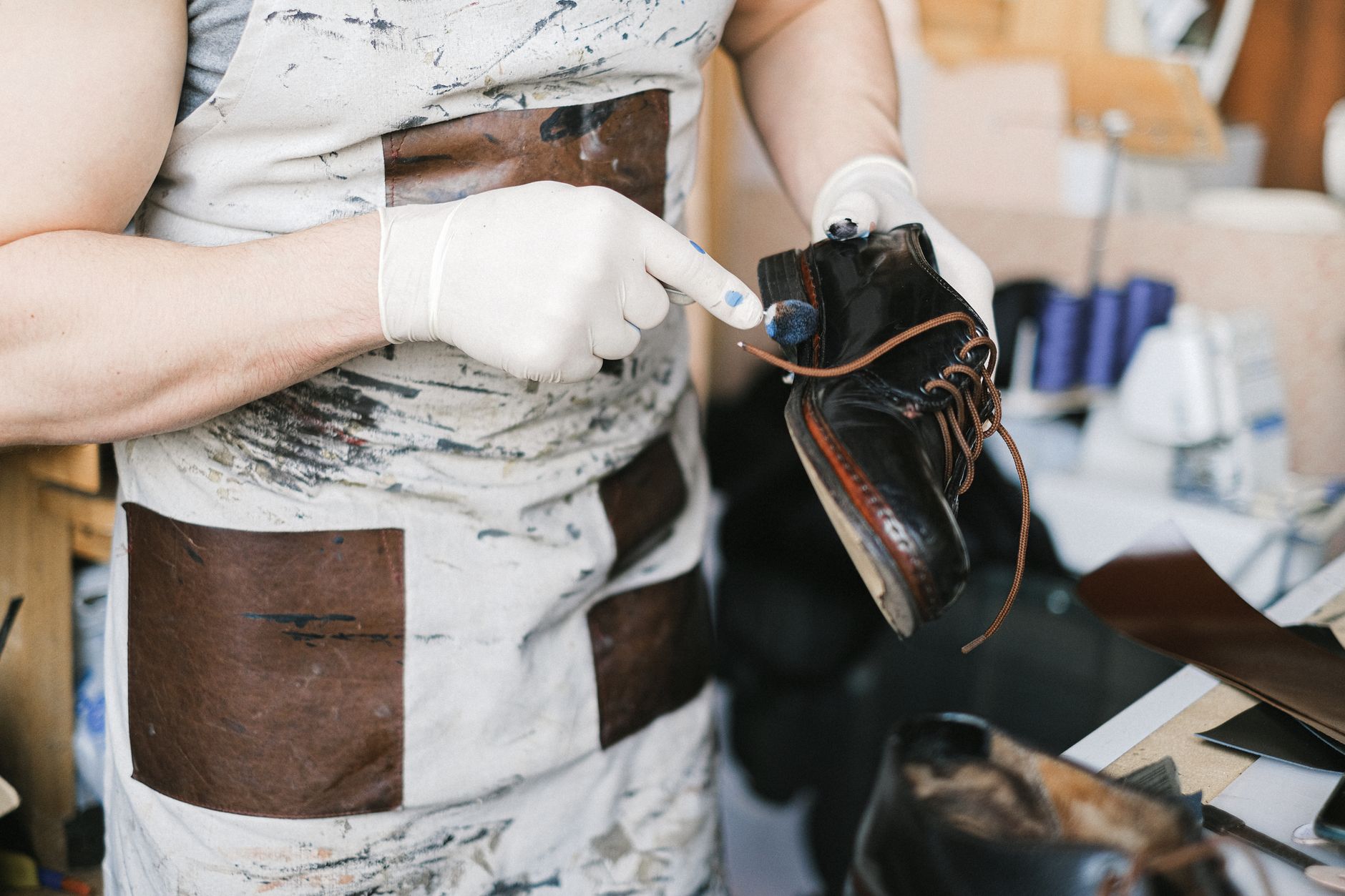
What a good colourist does is closer to glazing than to painting. Thin washes of pigment go on one after another, each drying before the next, so that light passes through the upper layers and bounces off the ones beneath. That is why a great patina has depth you cannot photograph properly: the brown you see is actually four or five browns stacked in transparent film. Dark the edges, lift the centre of the toe, feather a little green or violet into the flex point where the shoe will crease anyway — and the result reads less like a colour than like weather.
None of it works on sealed leather. Push pigment against a finished surface and it beads and skids. The craft is entirely a conversation between the artisan's hand and the openness of the crust.

Consider what a smoky grey patina asks of a maker. Grey is one of the hardest finishes to pull off convincingly, because it lives or dies on subtlety — too even and it looks like paint, too heavy and it goes muddy. Que Shebley's Script Two wholecut, hand-worked on Italian crust and finished as a limited piece, is the sort of object that only exists because someone chose the harder material. A wholecut — cut from a single piece of leather with almost no seams — hides nothing, so the leather has to be flawless and the colouring has to be flawless, both at once. There is nowhere for a mistake to escape.

Why no two pairs are the same
This is the part collectors love and manufacturers fear: hand-patina cannot be perfectly repeated. Every hide takes pigment slightly differently. Every artisan's hand moves at its own pressure and speed. Two pairs from the same order will be siblings, not clones — recognisably related, quietly individual. For anyone who has spent a decade watching luxury flatten into sameness, that variance is the entire appeal.
It also changes how you should think about wear. A well-made patina isn't a coat of paint waiting to chip; it's part of the leather's surface, and it will keep evolving. The high-touch points — the toe, the ball of the foot, the heel — will burnish and deepen with time and polish. Where a sealed factory shoe slowly looks tired, a crust-leather patina tends to look better at five years than at five days, provided you feed it.
A double monk like the Dilya makes the case in a warmer register. On that expanse of vamp above the two buckles, a colourist has room to run a proper gradient — richer at the edges, glowing at the centre — the kind of movement that turns a straightforward brown shoe into something people ask about. It is the same principle as the grey wholecut, dressed for a different mood.
Living with a hand-coloured shoe
None of this craft survives neglect. Crust-leather patina rewards a light, consistent hand far more than an occasional heavy one. A few habits go a long way:
- Feed before you shine. A conditioning cream keeps the fibres supple so the colour doesn't dry out and dull. Do it before the pigment ever looks thirsty.
- Match, don't fight, the tone. Use a neutral or closely matched cream polish; a wildly off colour can cloud the gradient you paid for.
- Build shine in thin layers. The same logic as the patina itself — many light coats, buffed patiently, beat one thick one.
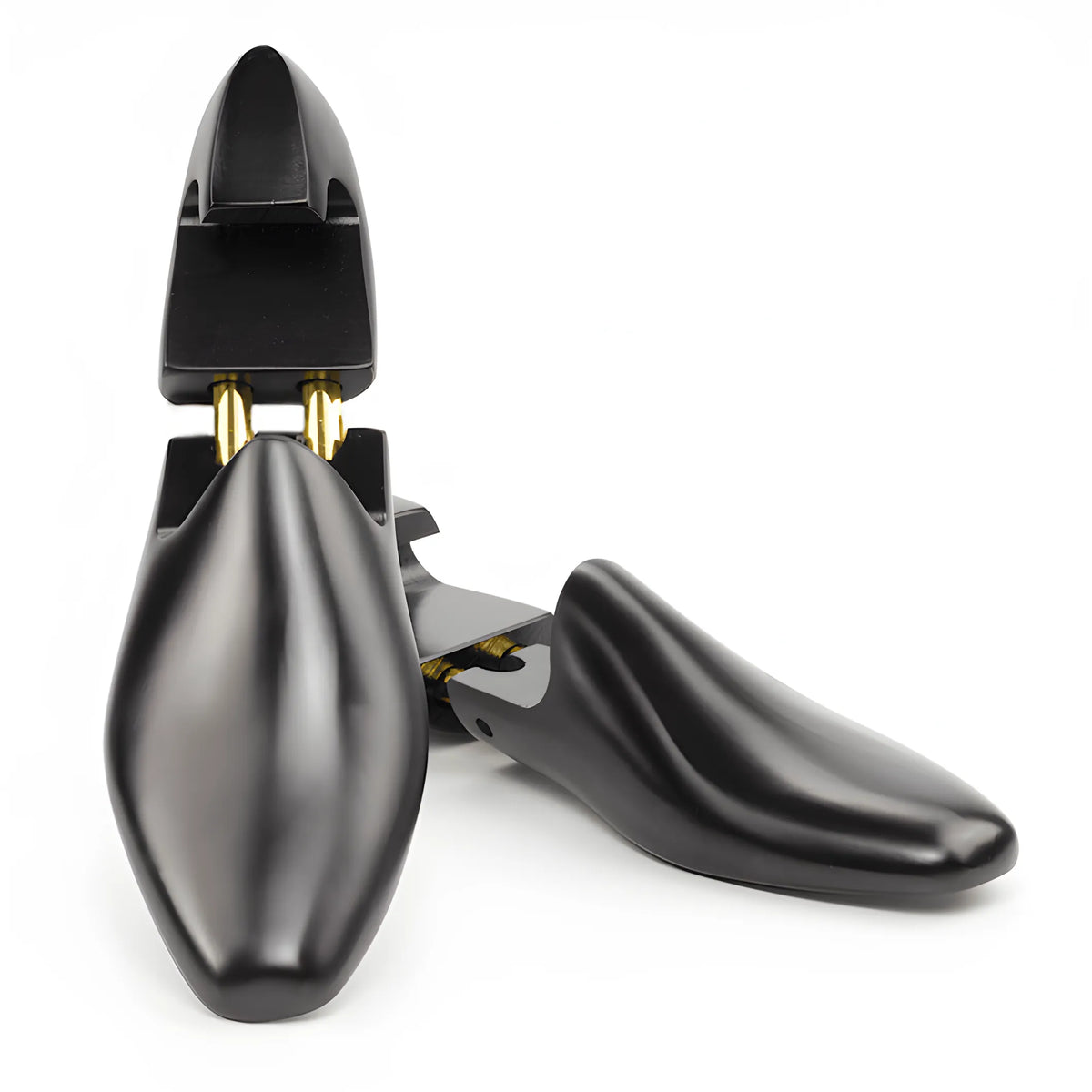
- Rest and reshape. Rotate pairs and give them a day between wears with a cedar tree inside, so the leather dries in its proper shape rather than around its creases.
The larger point is that patina is not a finish applied to a shoe. It is a relationship between a raw material and a human being, one that continues long after the box is opened. Crust leather is what makes that relationship possible — the honest, undecided hide that agrees to become whatever a skilled hand, and then a life of wearing, decides to make of it.
Most luxury tries to arrive perfect and stay that way. The best patina does the opposite. It shows up unfinished on purpose, and spends years getting more interesting. In a market obsessed with the flawless, there is something almost radical about a shoe that would rather be alive.

Deja un comentario
Este sitio está protegido por hCaptcha y se aplican la Política de privacidad de hCaptcha y los Términos del servicio.