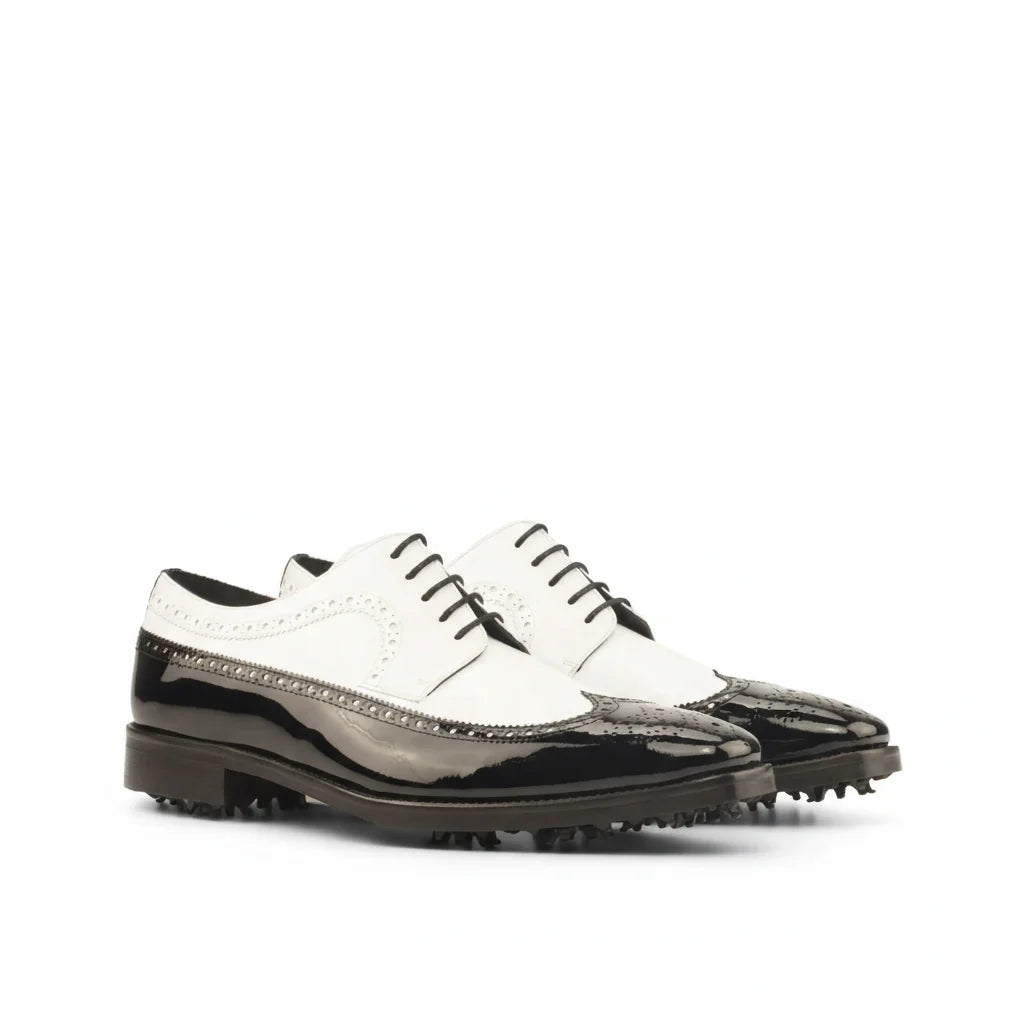
Spikes and Spectators: How the Golf Shoe Became Menswear's Best-Dressed Athlete

There is a photograph that lives somewhere in the collective menswear imagination, even if you have never seen a specific version of it: a man on a clipped fairway in the 1920s, plus-fours ballooning at the knee, an argyle sweater, and on his feet a pair of two-tone shoes so crisp they look painted. He is playing a game, but he is dressed like he is going to lunch afterward. That, in a sentence, is the enduring appeal of the golf shoe — a piece of athletic equipment that has never quite been able to stop being handsome.
Most sports footwear ages badly. The running shoe of 1985 looks like an artifact; the tennis shoe of the 1970s survives only through ironic revival. The golf shoe is the rare exception. Strip away the spikes and you are left with a design language — brogueing, saddles, wingtips, buckles — that has been quietly borrowed by the dress-shoe world for a century. It is the athlete that dressed for dinner.
Born on the Links, Raised in the Clubhouse
The golf shoe as we know it emerged from a practical problem: Scottish and English players needed grip on wet, sloping turf. Early solutions were brutal — hobnails hammered into the soles of ordinary boots, then screw-in metal studs by the turn of the twentieth century. But golf, from its earliest gentleman-amateur days, was a game played by people who cared how they looked. The shoe had to solve the traction problem without embarrassing the wearer at the nineteenth hole.
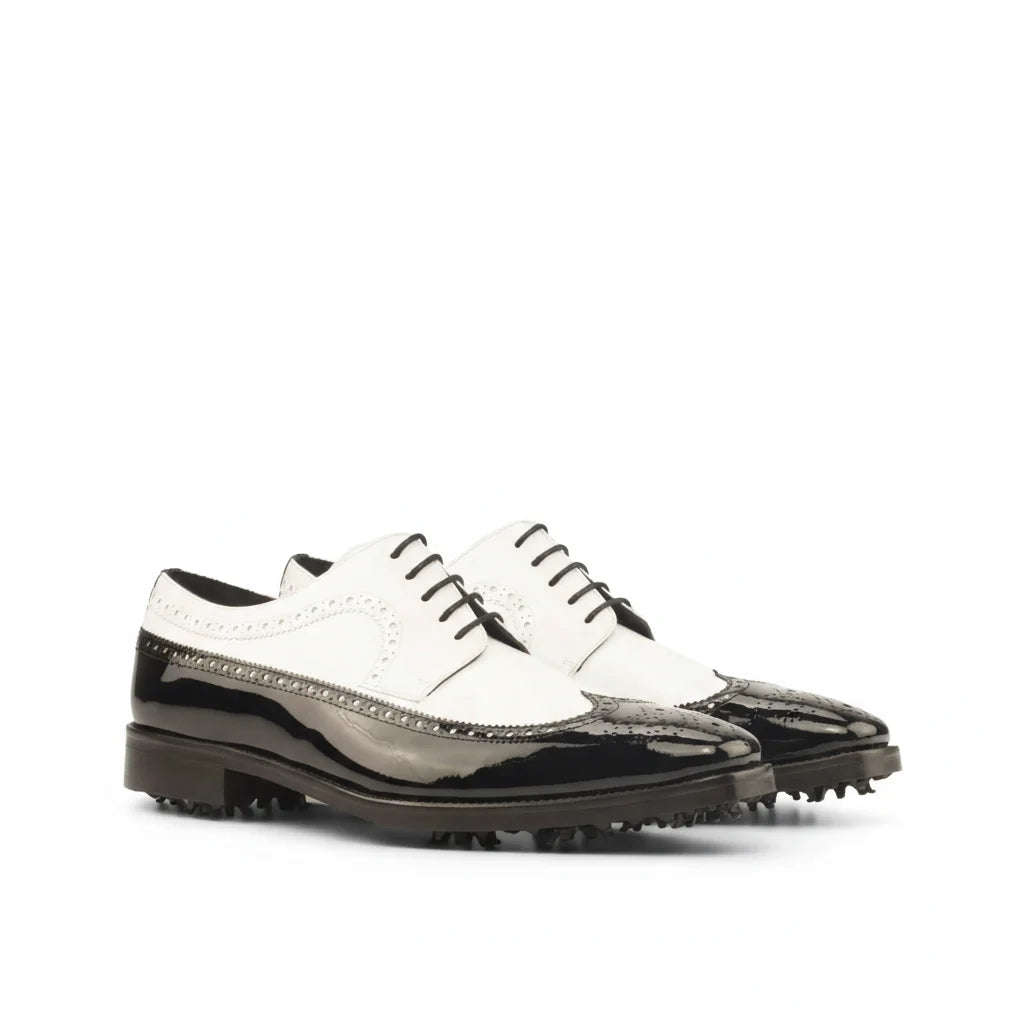
The answer arrived in the form of the brogue. Those decorative perforations we now associate with formal Oxfords were originally functional, punched into leather to let water drain from shoes worn across the boggy Scottish and Irish countryside. Golf inherited the brogue for exactly this reason, then kept it because it looked marvelous. By the 1920s, the full-brogue wingtip in white-and-tan or black-and-white had become the uniform of the fashionable player, and the game's biggest stars — the Walter Hagens of the era, men who dressed as flamboyantly as any film idol — turned the fairway into a runway.

The Spectator's Long Shadow
Here is where the golf shoe's influence spills off the course entirely. The two-tone construction born on the links became the spectator shoe — so named because it was worn by well-heeled onlookers at cricket matches, regattas, and, yes, golf tournaments. It migrated from sport into the wider wardrobe of the Jazz Age, worn by dandies, bandleaders, and eventually gangsters, until it became shorthand for a certain kind of confident, slightly dangerous elegance.
The saddle shoe followed a parallel path. That contrasting band of leather across the instep — originally reinforcement, later pure decoration — became a staple of American collegiate style, then of the golf course, then of the jazz club and the sock hop. Few silhouettes have travelled so freely between the serious and the playful. When you see a modern two-tone golf shoe, you are looking at a design that has been a country-club fixture, a rebel's flourish, and a preppy icon, sometimes all at once.

Que Shebley's Darius belongs squarely in this lineage — a saddle silhouette that reads as heritage rather than costume. It is the kind of shoe that looks entirely at home striding to the first tee, but would not embarrass itself walking into a clubhouse dining room afterward. That dual citizenship is the whole point of the golf shoe, and always has been.

The Great Divide: Technology vs. Tradition
Somewhere in the last few decades, the golf shoe split into two families. On one side sits the technical shoe — waterproof membranes, molded polymer soles, the aesthetic of a running trainer with cleats. It is undeniably effective, and if you are chasing a scratch handicap, it may be the sensible choice. On the other side sits the traditional dress golf shoe, which never forgot that golf began as a game of tailoring as much as athletics.
The metal spike, banned or discouraged at many courses for the damage it does to greens, has largely given way to soft plastic cleats — a change that, conveniently, made the classic leather golf shoe more wearable off the course than ever. What remains is a shoe that borrows the vocabulary of fine dress footwear: hand-finished leather, proper brogueing, structured lines. The buckled and Oxford variants in particular blur the line so thoroughly that, sole aside, they would pass muster with a suit.

Consider the double-buckle golf shoe — a monk-strap sensibility applied to the fairway. It is a design that argues, correctly, that there is no reason a shoe built for walking eighteen holes cannot also be one of the sharpest things in your rotation. For the player who treats the round as a social occasion as much as a sport — which is to say, most of them — it is a quiet triumph of intent over utility.
Dressing the Modern Player
If you want to wear the golf shoe the way it was meant to be worn — with a sense of occasion — a few principles hold up regardless of era:
- Let the shoe lead. A two-tone or brogued shoe is the loudest thing on the course. Keep the rest tonal — solid trousers, a plain or subtly patterned polo — and let the footwear carry the personality.
- Match the formality of the sole to the sky. A dressy Oxford golf shoe suits a manicured members' course; a sturdier saddle handles a rougher, older links.
- Care for the leather. Turf, morning dew, and clubhouse gravel are hard on hand-finished leather. A cedar shoe tree and a regular pass with leather cream will keep a good pair looking new for seasons.
- Wear them home. The best compliment you can pay a well-made golf shoe is to swap the cleats, add a leather sole guard, and wear it to lunch. If it looks wrong off the course, it was never really a great shoe.

The Hogan Oxford makes the case as neatly as any shoe can: a proper cap-toe Oxford, right down to the plaid detailing, that happens to be engineered for the course. It is the descendant of those hand-punched brogues that first crossed the Scottish moors, and it carries the same message they did a century ago — that a man can be serious about his game and serious about how he looks doing it, and that these have never been separate ambitions.
The Last Well-Dressed Sport
Golf is one of the few remaining arenas where a grown man can dress with genuine flourish and be applauded rather than mocked. The tennis whites have loosened into activewear; the polo field is a rarefied few. But golf still holds the line, still rewards the player who arrives looking like he means it. The shoe is where that intention shows first and lasts longest — the piece of kit that outlives the round, the season, and, if it is well made, most of the wardrobe around it. A century of dandies, hustlers, and club champions can't all have been wrong.

Laisser un commentaire
Ce site est protégé par hCaptcha, et la Politique de confidentialité et les Conditions de service de hCaptcha s’appliquent.