The Holes Were the Point: How a Waterlogged Irish Farm Shoe Became a Symbol of Taste

Look closely at a good pair of brogues and you are looking at a joke that history forgot to explain. Those fastidious little perforations — the ones a salesman will tell you signal formality, or the lack of it — began as holes punched clean through the leather so a farmer's foot could drain. The most decorative detail in a man's wardrobe started as plumbing.
It is my favourite fact about shoes, because it upends the whole hierarchy we've built around them. We treat brogueing as ornament, a flourish reserved for tweed weekends and country weddings. The people who invented it were trying not to get trench foot crossing a bog. Understand that, and you understand something true about menswear generally: almost everything we now call "elegant" was once, simply, useful.
Wet feet and clever holes
The word comes from the Gaelic brog, meaning shoe, and the shoe in question was a rough, untanned thing worn across the boggy uplands of Ireland and the Scottish Highlands. Cross enough waterlogged ground and any closed shoe becomes a bucket. So the wearers punched holes in the uppers, top and bottom, letting the water run straight through as they walked. The leather stayed workable; the foot stayed drier than it had any right to be.
For centuries this was strictly outdoor kit — the footwear of gamekeepers, gillies and anyone whose day involved standing in the wet. No self-respecting Victorian would have worn a perforated shoe into a drawing room any more than he'd have worn his fishing waders. The brogue was rural, damp and faintly disreputable.
Then, as tends to happen, the aristocracy went shooting and fell in love with the kit. By the early twentieth century the country pursuits of the landed classes had become aspirational theatre, and the sturdy, decorated shoes that came with them followed the gentry indoors. The holes lost their job and kept their looks. What had been drainage became decoration — a memory of function, tooled into leather by craftsmen who now punched the perforations precisely because they were beautiful, not because anyone's feet were wet.

The man who made it acceptable in town
The brogue's social climb owes a great deal to the Duke of Windsor, then Prince of Wales, who in the 1920s and 30s treated the rules of dress as suggestions. He wore brogues with lounge suits, put brown shoes where black ones were expected, and generally dragged country informality into the city with the confidence of a man who would never be turned away from anywhere. Where he led, the well-dressed followed. The full brogue — the wingtip, with its swooping W-shaped toe cap and dense perforation — became a legitimate town shoe, and the fashion houses of the following decades never let it go.
Cinema did the rest. The wingtip became visual shorthand for a certain kind of man: Fred Astaire's spectator brogues, dancing across a black-and-white floor; the sharp-suited gangsters and G-men of American film, whose two-tone broguing signalled money that hadn't quite finished laundering. By mid-century the shoe carried a whole vocabulary — rakish, established, slightly dangerous — that had nothing to do with keeping water off a Highland estate.

A field guide to the perforation
The trouble with brogues is that the word is thrown at almost anything with holes in it. It helps to know what you're actually looking at, because the amount of decoration changes the shoe's register entirely.
- Full brogue (wingtip): The pointed toe cap sweeps back along both sides in a W or M shape, with a medallion of perforations on the toe. The most decorative, the most country in spirit — and, worn well, the most charismatic.
- Semi-brogue: A straight toe cap with perforation and a toe medallion, but no wings. The diplomat of the family — dressier, quieter, at ease with a suit.
- Quarter brogue: Perforation along the toe-cap seam only, no medallion. Nearly as formal as a plain cap-toe, with just a whisper of ornament.
- Longwing: The American maximalist, where the wing runs all the way round to the heel. Deeply unfashionable for years, now quietly beloved by people who know.
The wingtip's swagger works because it plays both sides — rugged pedigree, refined execution. A full brogue like Que Shebley's Gaya, cut as a unisex wingtip and finished in the house's Italian crust leather, is a case study in that tension: the perforation reads as heritage, but the hand-finishing and multi-tonal patina drag it firmly into the present.

From the bog to the boot
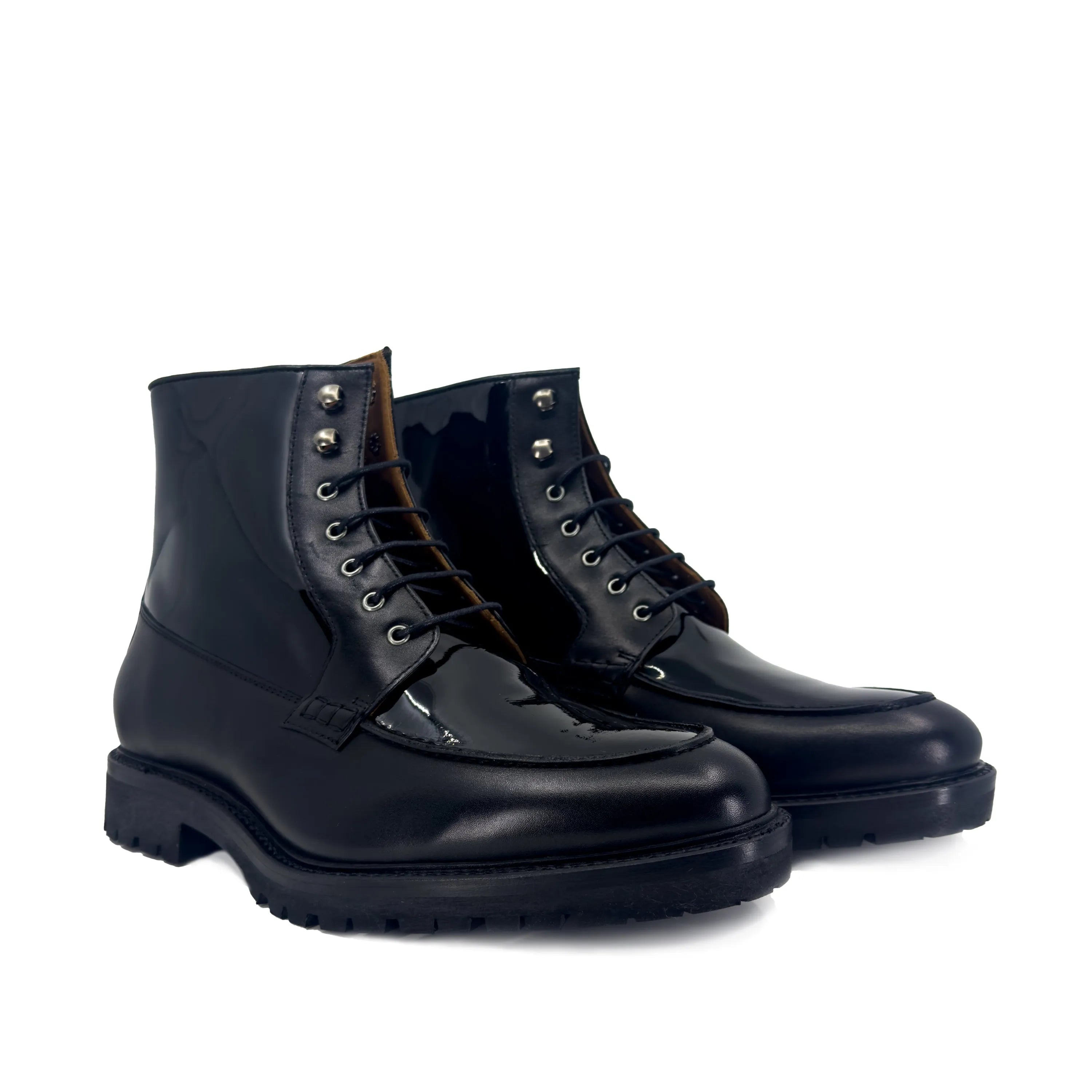
The brogue's other honest home is the boot, which makes sense: if the point was ever to survive rough ground, a higher shaft only ever helped. The brogue boot — perforated, capped, laced high — is one of the great winter shoes, equal parts practical and theatrical. It looks superb under trousers with a break, under raw denim, or storming through the kind of weather that would ruin lesser footwear.
What I like about a piece like the Lila Military Brogue Boot is that it refuses to apologise for its own history. The military brogue was a real thing — service boots given decorative perforation and toe medallions, worn by officers who wanted a shoe that could parade and march. Rendered in a bold patent finish, it reads less as costume and more as a statement: heritage construction, no interest in blending in.

How to wear the joke well
The great fear with brogues is fussiness — that all those holes will read as trying too hard. The fix is context. A full brogue wants texture around it: flannel, tweed, corduroy, heavier worsteds, honest denim. It looks slightly lost against a razor-sharp city suit, which is precisely where a plain cap-toe or a whole cut belongs. The more decorated the shoe, the more relaxed the cloth it likes to keep company with. This is the rule the Duke of Windsor understood instinctively and broke on purpose.
Colour matters too. The brogue's country soul responds beautifully to warmth and depth, which is why a hand-applied patina — those layered, sunlit browns and tobaccos that only get better with wear — suits it so well. A flat black wingtip can look severe; the same shoe in a mottled chestnut looks like it has walked in from somewhere interesting.
Two hundred years on, we've turned a drainage solution into a symbol of taste, which is either absurd or perfectly logical depending on your mood. I lean toward logical. The best things in a man's wardrobe almost always started as answers to real problems — the trench coat, the field jacket, the deck shoe, the brogue. The holes were the point. That they became beautiful too is just history doing what it does best: keeping the good bits and quietly forgetting why.

Laisser un commentaire
Ce site est protégé par hCaptcha, et la Politique de confidentialité et les Conditions de service de hCaptcha s’appliquent.