Articolo: Two Buckles, No Laces: The Quiet Swagger of the Double Monk
Two Buckles, No Laces: The Quiet Swagger of the Double Monk

There is a particular kind of man who refuses to lace his shoes and refuses to slip them on. He wants something in between — something with a little friction, a little ceremony, a little showmanship. For him, the answer has always been the monk strap, and specifically its more theatrical sibling, the double monk: two buckles marching across the instep, no laces in sight, quietly announcing that the wearer has thought about this.
It is a shoe with an unusual gravitational pull. Put a double monk on an otherwise conservative outfit and the whole thing tilts — more Milan than Mayfair, more rakish than reverent. That tension between formality and flair is exactly why it has survived centuries while flashier styles came and went.
From the Monastery to the Boardroom
The origin story is right there in the name. The design is usually traced to Alpine monks who wanted something sturdier than a sandal but less fussy than a laced boot for work in the fields and cloisters. The buckle-and-strap closure was practical: easy to adjust, hard to trip over, quick to fasten with cold hands. It was footwear built for labor, not for looking good.
For most of its life the monk shoe remained a quiet, single-buckle affair — a slightly unusual choice tucked between the Oxford and the derby in the hierarchy of men's dress shoes. The double monk, with its second strap, was the flourish that pushed it from understated to assertive. It gained real traction in the twentieth century, helped along by the Duke of Windsor, whose restless appetite for anything that broke the rules of correct dress made him an inadvertent patron of nearly every charismatic menswear idea.
The shoe's modern renaissance, though, is a more recent story. Somewhere around the late 2000s, as men grew bored of the ten-thousandth plain black Oxford, the double monk became the breakout detail of the tailoring revival. Pitti Uomo peacocks wore them with cropped trousers and bare ankles. Designers and old houses alike — from the Northampton stalwarts to the Italian ateliers — leaned in. For a few years it was arguably the most photographed dress shoe in menswear.

Why It Works When So Much Doesn't
The genius of the double monk is positional. It sits precisely in the gap the rest of the dress-shoe canon leaves open. An Oxford is formal and a little serious; a loafer is relaxed and a little louche. The double monk borrows the closed, polished silhouette of the former and the slip-on ease of the latter, then adds a piece of visible hardware that neither can offer. It is the dressy shoe you wear when you want some evidence of personality.
That hardware does a lot of quiet work. The angle of the straps, the shape of the buckles, the way the second strap overlaps the first — these are the details that separate a thoughtful pair from a costume. The best versions keep the lines clean and the buckles modest. The worst pile on oversized metal and turn a classic into a novelty.
There is also a question of attitude. Monk straps reward a certain confidence, because you cannot pretend they are invisible. You either commit to the buckles or you don't. Men who wear them well tend to treat them the way they treat a good watch — as a chosen flourish rather than an accident.

The Exotic End of the Spectrum
Because the double monk already carries a note of flamboyance, it takes beautifully to richer materials. In smooth calf it reads as sharp office wear. In suede it softens into weekend tailoring. And in an exotic skin, it crosses fully into statement territory — the kind of shoe worn by men who have graduated from caring whether anyone approves.
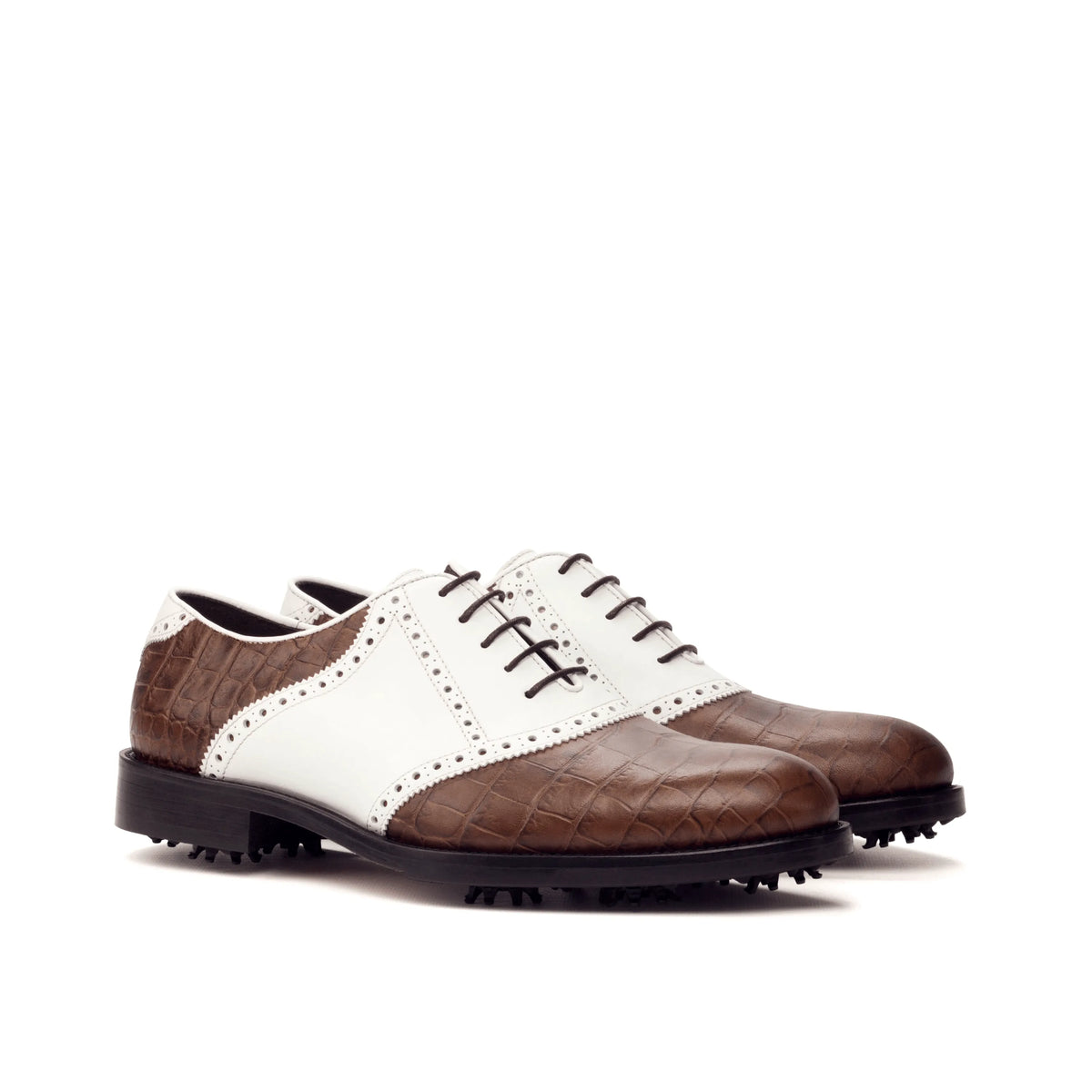
Que Shebley's Amiri Alligator Double Monk is a good study in how far the style can be pushed before it tips over. The burgundy alligator gives the uppers a quiet depth that catches light at the toe and along the straps, while the double-buckle silhouette keeps the whole thing grounded in a recognizable classic. It is loud in the way a well-chosen tie is loud: deliberate, not desperate.

Burgundy, incidentally, is the shrewd man's choice here. Black monk straps can feel severe; mid-brown is safe to the point of forgettable. A deep oxblood or burgundy flatters grey flannel, navy worsted, and even denim, and it carries the faint air of old European tailoring without trying too hard.
How to Wear a Double Monk
The shoe is more flexible than its reputation suggests. A few principles keep it on the right side of the line:
- Treat it as the centerpiece. If the shoes have personality — exotic skin, a strong color, patina — let the rest of the outfit stay disciplined. Monochrome tailoring with a loud monk strap always beats a loud suit with loud shoes.
- Mind the break. Double monks love a slightly shortened trouser that shows the straps. A puddle of fabric hides exactly the feature you paid for.
- Buckle both, but not tightly. The straps should lie flat and secure, not strain. A buckle pulled to its last hole looks like an afterthought.
- Dress them down with intent. Suede or textured leather monks work with chinos, knitwear, and unstructured jackets — the business-casual Trojan horse.
The Matter of Matching Leather
Old sartorial lore insists that shoes and belt should agree. The rule is less rigid than it once was, but when you are wearing a shoe with this much visual weight, a coordinating belt still steadies the whole look. The point is not identical leather — it is a shared tonal family, so the eye reads the outfit as composed rather than assembled at random.
A hand-finished patina belt, with its layered browns and brass hardware, echoes the warmth of a burgundy or tan monk strap without slavishly copying it — the modern, grown-up way to honor the old rule.
The Last Word on the Buckle
Trends in menswear move in waves, and the double monk has already weathered its peak hype and the inevitable backlash that followed. What remains, now that the Pitti frenzy has cooled, is a shoe that was always better than its moment of fashionability suggested. It is characterful without being clownish, formal without being funereal, and — crucially — it still looks like a decision.
That is the quiet luxury of the monk strap. It gives a man a way to be noticed that doesn't require saying anything at all. Two buckles, no laces, and no need to explain.

Lascia un commento
Questo sito è protetto da hCaptcha e applica le Norme sulla privacy e i Termini di servizio di hCaptcha.