Two Buckles, One Statement: The Long, Strange Rise of the Monk Strap

There is a specific kind of man who wears monk straps. He is not showing off, exactly, but he is not blending in either. He has decided that the oxford is a touch too obedient and the loafer a touch too relaxed, and he has landed on something in between: a shoe closed by buckles rather than laces, worn by someone who wants you to notice he made a choice. The monk strap is menswear's great middle path — formal enough for a suit, idiosyncratic enough to signal that its wearer has opinions.
It is also, quietly, one of the oldest shoe silhouettes still in regular circulation. And its journey from cloistered European workshops to the front rows of Pitti Uomo is far stranger than its buttoned-up reputation suggests.
The Shoe That Came From the Monastery
The name is not marketing. The monk strap really does trace back to monastic footwear — most accounts point to Alpine monks in the late medieval period who needed something sturdier than a sandal for cold stone floors and outdoor labor, but simpler and more secure than the laced boots worn beyond the monastery walls. The solution was a closed shoe held shut by a strap and buckle across the top of the foot. Practical, durable, and — crucially — quick to fasten. A monk could get on with his day.
That utilitarian DNA never fully left the shoe. Even in its most polished modern form, the monk strap retains a hint of function-first honesty. There is no bow to fuss with, no lacing ritual. You slide your foot in, pull the strap, and go. It is the closest a dress shoe comes to the ease of a loafer while still committing to the structure of a proper welted shoe.

Single, Double, and the Great Buckle Escalation
For most of its history, the monk strap was a single-buckle affair — restrained, ecclesiastical, a shoe that whispered. The single monk remains the more conservative choice, and if you work somewhere that still frowns on anything short of a black cap-toe oxford, it is the version that will slip under the radar.
Then came the double monk, and with it, the shoe's transformation into a menswear signal. Two buckles instead of one, stacked across the instep, the strap wider and the presence louder. The double monk is not subtle. It draws the eye downward and holds it there. For decades it lived quietly in the wardrobes of well-dressed Europeans, but its real coronation came in the 2010s, when a generation of style bloggers, tailors, and Pitti peacocks seized on it as the ultimate expression of sartorial fluency. Wearing double monks said: I know the rules well enough to bend them.
What tipped the shoe over into icon status was patina — the hand-finishing technique borrowed from French shoemaking, where undyed crust leather is coloured by hand in layers, producing a depth and variation no factory dye job can match. A double monk in a mottled, hand-burnished brown is the sartorial equivalent of a good espresso: dark, complex, and impossible to rush.

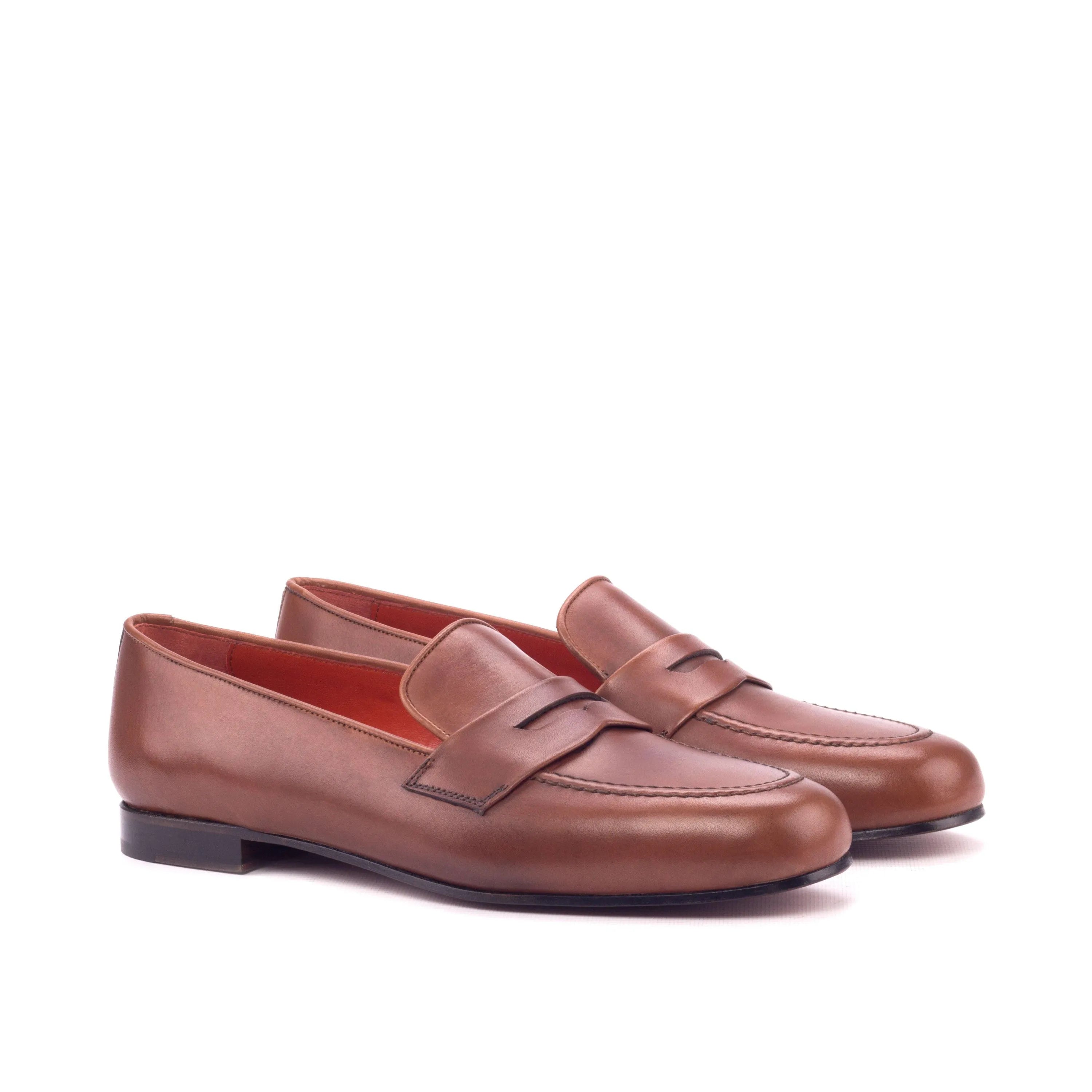
Que Shebley's Frango is a fair illustration of why the hand-finished double monk endures: the colour shifts across the vamp and strap, so the shoe reads differently in daylight than under a restaurant's warm bulbs. That variation is the whole point. A monk strap in flat, uniform leather can look a little corporate. Give it a proper patina and it becomes something closer to an object you'd collect.
How to Actually Wear One
The monk strap occupies a peculiar tonal register. It is dressier than most people assume and more relaxed than the buckles suggest. The trick is to lean into that ambiguity rather than fight it.
- With tailoring: A double monk in brown or oxblood is superb with a navy or grey suit, and frankly more interesting than the default oxford. It reads especially well in a business-casual context — a soft jacket, no tie, trousers with a clean break.
- With denim: This is where the monk earns its keep. A raw indigo jean, a knit or an unstructured blazer, and a patina double monk is the outfit that makes people ask where you got your shoes.
- The buckle question: Some men fasten both buckles snugly; others leave the top one slightly looser for a rakish, undone effect. There's no wrong answer, but the latter has been a Pitti signature for years for a reason.
- Avoid: Black monk straps with black tie. Formalwear wants a plain oxford or an opera pump. The monk is a shoe for the space between codes, not the strictest one.
The Company It Keeps
The monk strap belongs to a small family of shoes that reward a man for having a point of view. It sits alongside the tassel loafer — that other establishment favourite with a rebellious streak — and a step above the everyday derby in terms of statement value. Where it beats both is versatility across the seasons: substantial enough to carry a boot-heavy autumn outfit, sleek enough to work with a lightweight summer suit.
If you're building a rotation, the logic runs something like this. You already own, or should own, a plain oxford for the days that demand seriousness and a good loafer for the days that don't. The monk strap is the third shoe — the one you reach for when the occasion is undefined and you want your footwear to do a little of the talking. For men who prefer that conversation to happen in richer tones, a burnished slip-on like Que Shebley's Dymo Flex covers the casual end, but the monk is where structure and personality meet most cleanly.
Why the Buckles Still Matter
There's a reason the monk strap survived when so many older shoe styles vanished into museum vitrines. It solved a real problem — secure, fast, dignified footwear — and it did so with a small flourish of hardware that gives every wearer a chance to express something. The buckle is not just a closure; it's punctuation. It's the shoe saying it had an idea and decided to see it through.
Nearly a thousand years after a cold Alpine monk first strapped one on, that idea still holds. In a wardrobe increasingly dominated by things that slip on, zip up, or fasten themselves, there's something deeply satisfying about a shoe that asks you to reach down, pull a strap, and set a buckle. It's a small ritual — and small rituals are what separate getting dressed from merely covering up.

اترك تعليقًا
This site is protected by hCaptcha and the hCaptcha Privacy Policy and Terms of Service apply.